(
(
Perfomance
Perfomance
)
)
The HYROX Off-Season: Why and What?
The HYROX Off-Season: Why and What?
How to plan the HYROX off Season
How to plan the HYROX off Season
by
Dr Dan Plews
5
min read
Making the Most of Your HYROX Off-Season
Many athletes struggle with the period after a major event, or the final race of the season, known as the off-season. You've been so focused on your training for and nailing your event, and likely gotten into a routine of balancing your training programme around work and family. After the event, motivation can dwindle, and it can be tricky to figure out what it is you are trying to do with your training, and even if you should be training at all!
The purpose of the off-season, which is essential, is to physically and mentally freshen up whilst minimising the loss of those hard-earned adaptations you accrued in the build-up to the previous event. You can't always just keep training; it is necessary to pull back, let any niggles clear, and reconnect with the other aspects of your life that training has dominated. Not taking an off-season leaves you at risk of physically or mentally burning out in the next programme.
In this blog, I will summarise my key recommendations for tackling the off-season, what we are trying to achieve, and how we can practically achieve that.
Detraining: What Happens When We Stop Training?
If we stop training, we start to lose some of the hard-earned adaptations we had gained through training, with obvious effects on performance. The loss of adaptations when we stop training is called detraining, and detraining can be considered in terms of its short (<4 weeks of rest) and long (>4 weeks of rest) effects.
The detraining-induced loss of training adaptations was brilliantly reviewed by Inigo Mujika and Sabino Padillo back in 2000 (1, 2). They described how, with short-term detraining, we experience a relatively rapid loss of aerobic capacity (VO2max), likely resulting from reduced blood volume. From a metabolic standpoint, we can expect reduced fat and increased carbohydrate oxidation at given speeds and power outputs, as well as lowered muscle glycogen stores and lactate thresholds. This all simply reflects lost fitness. Unsurprisingly, endurance performance goes down, too.
These effects are exacerbated when detraining is extended for longer than four weeks. As HYROX athletes, we may also reduce our slow-twitch fibre proportion over time, which matters given the sustained aerobic demand across all eight running kilometres and the cumulative fatigue of the functional stations. These detraining-induced changes, which have all been shown in the literature, are perhaps not surprising; we all know we lose fitness when we stop training.
What is perhaps less discussed in the HYROX context is the loss of strength and neuromuscular adaptations. A complete training break also leads to decrements in force production, movement efficiency, and the specific strength qualities that underpin stations like the sled push and pull, sandbag lunges, and wall balls. These adaptations can take time to rebuild, which makes the off-season approach all the more important.
It's Not All Doom and Gloom: What Training Should We Do in the Off-Season?
I have not written the above to try and scare you into training as hard as ever during your off-season. As I said, having downtime after a big event is important; we all need time to mentally and physically refresh and reconnect with aspects of our lives (family for many of us) that training may have dominated. We must also allow niggles we've picked up in training and racing to subside. What I am trying to do here is show why including a "maintenance stimulus", or a little training to keep you ticking over, is useful in the initial part of your off-season; the purpose of the maintenance stimulus is to hold on to as many of those adaptations as possible, whilst giving you the refresh you need after the build-up for an event. This mindset is similar to what we use when designing a taper, where training is designed to dissipate fatigue and maximise the retention of adaptations before an event (3). Furthermore, doing some training reduces the risk of injury when you return to training. It's well established in the literature that the greatest risk of injury is at the start of training after a resting period and under very high training loads (see Figure 1). Personally, as I've got older, taking 3-4 weeks of no training at all at the end of the racing season is a recipe for disaster. Research has shown an increased injury risk in athletes training at very low or very high volumes, reflecting a U-shaped relationship between training load and injury risk (5).
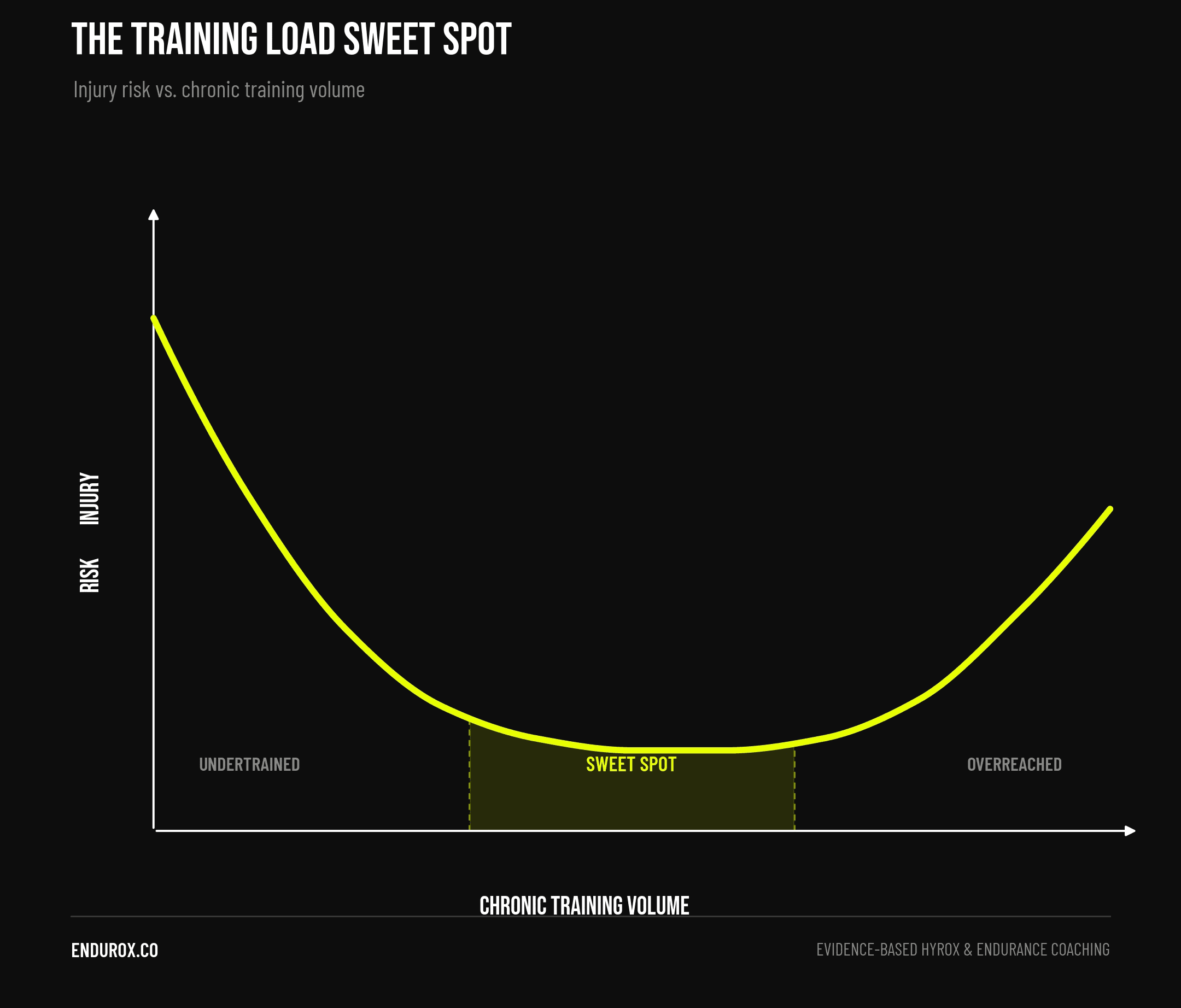
Figure 1. The U-shaped relationship between training volume and injury risk. Injury risk is at its highest at low and high training volumes.
So, in practical terms, what should we do to achieve this? Our overall training volume will need to go down, or it's not an off-season. My advice is to start your off-season by reducing your training frequency substantially; that is, the number of sessions you do each week. Reduce the duration of the sessions that you do, too, particularly the midweek sessions that are often harder to squeeze in around work and family commitments.
We typically think of off-season training in terms of emphasising low-intensity work, which is quite right and a valuable opportunity to work on your aerobic base before launching back into training again. Therefore, I recommend keeping almost everything you do below that first threshold in the moderate domain. That should keep the stress associated with the sessions low but keep stimulating those slow-twitch fibres that are so key in sustained efforts. Easy running is a natural fit here, and it's worth leaning into it: a few comfortable runs per week keeps your aerobic base ticking without the neuromuscular cost of high-intensity work. Getting out for hikes, recreational bike rides, or even a recreational team sport you enjoy are all great ways to stay active, accumulate aerobic stimulus, and stay mentally fresh.
Focusing on movement quality and technical work is also a great use of the off-season. HYROX rewards efficiency on every station, and the lower-pressure off-season environment is an ideal time to work on mechanics. Whether that's running gait, ski erg technique, rowing efficiency, or the positioning and pacing of the sled, small improvements in movement economy during the off-season can pay real dividends when racing resumes.
That said, some evidence supports including a small dose of high-intensity interval training in your off-season, perhaps once per week or so. A great study to support this was published in 2014 by Bent Ronnestad and colleagues in Norway (4). In that study, well-trained cyclists did either one high-intensity interval training session per week or none during an eight-week off-season. Those who did the intervals during the off-season better held on to things like their VO2max and, crucially, seemed to be in better shape even after the first training block following the off-season. Therefore, adding a small amount of high-intensity work during the off-season helped the athletes hold on to adaptations gained throughout the previous season, and provided them with a better springboard to launch into that first training block. I like to keep a little high-intensity work in my off-season for exactly this reason.
The Off-Season Is Your Best Friend for Resistance Training
Something else that absolutely needs to be utilised during this period is resistance training, and this is arguably even more critical for HYROX athletes than for any other endurance sport. HYROX is unique in that functional strength is not just a supplement to performance; it is the performance. The sled push and pull, farmers carry, sandbag lunges, and wall balls all require strength qualities that can be specifically targeted in the gym. The benefits of resistance training for all athletes are well established, including improved tissue resilience, movement economy, and reduced injury risk (6), but the off-season is when HYROX athletes can give it the dedicated time it deserves.
During the season, it can be difficult to prioritise the gym when running volume and HYROX-specific conditioning sessions are also competing for space in the schedule. The off-season removes that constraint. Rather than simply maintaining strength, this is the period where you should be genuinely trying to improve it.
Mastering the Major Lifts
The off-season is also the ideal time to invest seriously in the technique of the fundamental compound movements. When you are chasing race fitness in-season, there is rarely space to slow down and refine your mechanics. Now there is.
The back squat and front squat are the cornerstone movements for HYROX. Proper squat mechanics, including a braced midline, controlled descent, and drive from the floor through a neutral spine, underpin virtually every demanding station in the race. Wall balls are a squat with a throw; sandbag lunges require single-leg squat strength and stability; the sled push is driven by leg extension. Time invested in squat depth, bar position, and tempo during the off-season pays off across the whole race.
The deadlift and its variations, particularly the Romanian deadlift and trap bar deadlift, are equally important. Strong hip hinge mechanics are essential for the sled pull and farmers carry, and they build posterior chain resilience that protects the lower back across the full race duration. If your deadlift technique has felt rushed or inconsistent during the season, the off-season is the time to address it: lighter loads, more deliberate set-ups, and a focus on proprioception through the lift.
The overhead press and push press are worth dedicating time to as well. Efficient wall ball performance relies on a strong, stable overhead position and the ability to transfer power from the legs through the trunk and into the hands. Athletes who struggle to maintain an overhead position under fatigue lose significant time and energy on wall balls; addressing shoulder strength and mechanics now will pay dividends later.
Finally, loaded carry variations, including farmers carries, suitcase carries, and Yoke or sandbag carries, should feature regularly. These are not just HYROX-specific conditioning; they are exceptional tools for building the trunk stability, grip strength, and positional awareness that underpins almost every station. They also have a very low skill floor, making them easy to load progressively.
The principle across all of these movements is the same: use the lower-pressure off-season environment to build technical competence and maximal strength together. Arrive at the first training block of the new season not just fitter in the gym, but more capable, more efficient, and structurally more robust than you were at the end of the last one. That is a genuine competitive advantage.
References
1. Mujika I, Padilla S. Detraining: loss of training-induced physiological and performance adaptations. Part I: short term insufficient training stimulus. Sports Med. 2000;30(2):79-87.
2. Mujika I, Padilla S. Detraining: loss of training-induced physiological and performance adaptations. Part II: long term insufficient training stimulus. Sports Med. 2000;30(3):145-154.
3. Mujika I, Padilla S. Scientific bases for precompetition tapering strategies. Med Sci Sports Exerc. 2003;35(7):1182-1187.
4. Ronnestad BR, Hansen J, Ellefsen S. Block periodization of high-intensity aerobic intervals provides superior training effects in trained cyclists. Scand J Med Sci Sports. 2014;24(1):34-42.
5. Sousa CV, Sales MM, Nikolaidis PT, et al. Association between training characteristics and injury incidence in amateur endurance athletes: a retrospective cohort study. J Orthop Sports Phys Ther. 2018;48(2):135-143.
6. Lauersen JB, Bertelsen DM, Andersen LB. The effectiveness of exercise interventions to prevent sports injuries: a systematic review and meta-analysis of randomised controlled trials. Br J Sports Med. 2014;48(11):871-877.
7. Suchomel TJ, Nimphius S, Stone MH. The importance of muscular strength in athletic performance. Sports Med. 2016;46(10):1419-1449.
8. Beattie K, Kenny IC, Lyons M, Carson BP. The effect of strength training on performance in endurance athletes. Sports Med. 2014;44(6):845-865.
9. Ronnestad BR, Mujika I. Optimizing strength training for running and cycling endurance performance: a review. Scand J Med Sci Sports. 2014;24(4):603-61
Making the Most of Your HYROX Off-Season
Many athletes struggle with the period after a major event, or the final race of the season, known as the off-season. You've been so focused on your training for and nailing your event, and likely gotten into a routine of balancing your training programme around work and family. After the event, motivation can dwindle, and it can be tricky to figure out what it is you are trying to do with your training, and even if you should be training at all!
The purpose of the off-season, which is essential, is to physically and mentally freshen up whilst minimising the loss of those hard-earned adaptations you accrued in the build-up to the previous event. You can't always just keep training; it is necessary to pull back, let any niggles clear, and reconnect with the other aspects of your life that training has dominated. Not taking an off-season leaves you at risk of physically or mentally burning out in the next programme.
In this blog, I will summarise my key recommendations for tackling the off-season, what we are trying to achieve, and how we can practically achieve that.
Detraining: What Happens When We Stop Training?
If we stop training, we start to lose some of the hard-earned adaptations we had gained through training, with obvious effects on performance. The loss of adaptations when we stop training is called detraining, and detraining can be considered in terms of its short (<4 weeks of rest) and long (>4 weeks of rest) effects.
The detraining-induced loss of training adaptations was brilliantly reviewed by Inigo Mujika and Sabino Padillo back in 2000 (1, 2). They described how, with short-term detraining, we experience a relatively rapid loss of aerobic capacity (VO2max), likely resulting from reduced blood volume. From a metabolic standpoint, we can expect reduced fat and increased carbohydrate oxidation at given speeds and power outputs, as well as lowered muscle glycogen stores and lactate thresholds. This all simply reflects lost fitness. Unsurprisingly, endurance performance goes down, too.
These effects are exacerbated when detraining is extended for longer than four weeks. As HYROX athletes, we may also reduce our slow-twitch fibre proportion over time, which matters given the sustained aerobic demand across all eight running kilometres and the cumulative fatigue of the functional stations. These detraining-induced changes, which have all been shown in the literature, are perhaps not surprising; we all know we lose fitness when we stop training.
What is perhaps less discussed in the HYROX context is the loss of strength and neuromuscular adaptations. A complete training break also leads to decrements in force production, movement efficiency, and the specific strength qualities that underpin stations like the sled push and pull, sandbag lunges, and wall balls. These adaptations can take time to rebuild, which makes the off-season approach all the more important.
It's Not All Doom and Gloom: What Training Should We Do in the Off-Season?
I have not written the above to try and scare you into training as hard as ever during your off-season. As I said, having downtime after a big event is important; we all need time to mentally and physically refresh and reconnect with aspects of our lives (family for many of us) that training may have dominated. We must also allow niggles we've picked up in training and racing to subside. What I am trying to do here is show why including a "maintenance stimulus", or a little training to keep you ticking over, is useful in the initial part of your off-season; the purpose of the maintenance stimulus is to hold on to as many of those adaptations as possible, whilst giving you the refresh you need after the build-up for an event. This mindset is similar to what we use when designing a taper, where training is designed to dissipate fatigue and maximise the retention of adaptations before an event (3). Furthermore, doing some training reduces the risk of injury when you return to training. It's well established in the literature that the greatest risk of injury is at the start of training after a resting period and under very high training loads (see Figure 1). Personally, as I've got older, taking 3-4 weeks of no training at all at the end of the racing season is a recipe for disaster. Research has shown an increased injury risk in athletes training at very low or very high volumes, reflecting a U-shaped relationship between training load and injury risk (5).
Figure 1. The U-shaped relationship between training volume and injury risk. Injury risk is at its highest at low and high training volumes.
So, in practical terms, what should we do to achieve this? Our overall training volume will need to go down, or it's not an off-season. My advice is to start your off-season by reducing your training frequency substantially; that is, the number of sessions you do each week. Reduce the duration of the sessions that you do, too, particularly the midweek sessions that are often harder to squeeze in around work and family commitments.
We typically think of off-season training in terms of emphasising low-intensity work, which is quite right and a valuable opportunity to work on your aerobic base before launching back into training again. Therefore, I recommend keeping almost everything you do below that first threshold in the moderate domain. That should keep the stress associated with the sessions low but keep stimulating those slow-twitch fibres that are so key in sustained efforts. Easy running is a natural fit here, and it's worth leaning into it: a few comfortable runs per week keeps your aerobic base ticking without the neuromuscular cost of high-intensity work. Getting out for hikes, recreational bike rides, or even a recreational team sport you enjoy are all great ways to stay active, accumulate aerobic stimulus, and stay mentally fresh.
Focusing on movement quality and technical work is also a great use of the off-season. HYROX rewards efficiency on every station, and the lower-pressure off-season environment is an ideal time to work on mechanics. Whether that's running gait, ski erg technique, rowing efficiency, or the positioning and pacing of the sled, small improvements in movement economy during the off-season can pay real dividends when racing resumes.
That said, some evidence supports including a small dose of high-intensity interval training in your off-season, perhaps once per week or so. A great study to support this was published in 2014 by Bent Ronnestad and colleagues in Norway (4). In that study, well-trained cyclists did either one high-intensity interval training session per week or none during an eight-week off-season. Those who did the intervals during the off-season better held on to things like their VO2max and, crucially, seemed to be in better shape even after the first training block following the off-season. Therefore, adding a small amount of high-intensity work during the off-season helped the athletes hold on to adaptations gained throughout the previous season, and provided them with a better springboard to launch into that first training block. I like to keep a little high-intensity work in my off-season for exactly this reason.
The Off-Season Is Your Best Friend for Resistance Training
Something else that absolutely needs to be utilised during this period is resistance training, and this is arguably even more critical for HYROX athletes than for any other endurance sport. HYROX is unique in that functional strength is not just a supplement to performance; it is the performance. The sled push and pull, farmers carry, sandbag lunges, and wall balls all require strength qualities that can be specifically targeted in the gym. The benefits of resistance training for all athletes are well established, including improved tissue resilience, movement economy, and reduced injury risk (6), but the off-season is when HYROX athletes can give it the dedicated time it deserves.
During the season, it can be difficult to prioritise the gym when running volume and HYROX-specific conditioning sessions are also competing for space in the schedule. The off-season removes that constraint. Rather than simply maintaining strength, this is the period where you should be genuinely trying to improve it.
Mastering the Major Lifts
The off-season is also the ideal time to invest seriously in the technique of the fundamental compound movements. When you are chasing race fitness in-season, there is rarely space to slow down and refine your mechanics. Now there is.
The back squat and front squat are the cornerstone movements for HYROX. Proper squat mechanics, including a braced midline, controlled descent, and drive from the floor through a neutral spine, underpin virtually every demanding station in the race. Wall balls are a squat with a throw; sandbag lunges require single-leg squat strength and stability; the sled push is driven by leg extension. Time invested in squat depth, bar position, and tempo during the off-season pays off across the whole race.
The deadlift and its variations, particularly the Romanian deadlift and trap bar deadlift, are equally important. Strong hip hinge mechanics are essential for the sled pull and farmers carry, and they build posterior chain resilience that protects the lower back across the full race duration. If your deadlift technique has felt rushed or inconsistent during the season, the off-season is the time to address it: lighter loads, more deliberate set-ups, and a focus on proprioception through the lift.
The overhead press and push press are worth dedicating time to as well. Efficient wall ball performance relies on a strong, stable overhead position and the ability to transfer power from the legs through the trunk and into the hands. Athletes who struggle to maintain an overhead position under fatigue lose significant time and energy on wall balls; addressing shoulder strength and mechanics now will pay dividends later.
Finally, loaded carry variations, including farmers carries, suitcase carries, and Yoke or sandbag carries, should feature regularly. These are not just HYROX-specific conditioning; they are exceptional tools for building the trunk stability, grip strength, and positional awareness that underpins almost every station. They also have a very low skill floor, making them easy to load progressively.
The principle across all of these movements is the same: use the lower-pressure off-season environment to build technical competence and maximal strength together. Arrive at the first training block of the new season not just fitter in the gym, but more capable, more efficient, and structurally more robust than you were at the end of the last one. That is a genuine competitive advantage.
References
1. Mujika I, Padilla S. Detraining: loss of training-induced physiological and performance adaptations. Part I: short term insufficient training stimulus. Sports Med. 2000;30(2):79-87.
2. Mujika I, Padilla S. Detraining: loss of training-induced physiological and performance adaptations. Part II: long term insufficient training stimulus. Sports Med. 2000;30(3):145-154.
3. Mujika I, Padilla S. Scientific bases for precompetition tapering strategies. Med Sci Sports Exerc. 2003;35(7):1182-1187.
4. Ronnestad BR, Hansen J, Ellefsen S. Block periodization of high-intensity aerobic intervals provides superior training effects in trained cyclists. Scand J Med Sci Sports. 2014;24(1):34-42.
5. Sousa CV, Sales MM, Nikolaidis PT, et al. Association between training characteristics and injury incidence in amateur endurance athletes: a retrospective cohort study. J Orthop Sports Phys Ther. 2018;48(2):135-143.
6. Lauersen JB, Bertelsen DM, Andersen LB. The effectiveness of exercise interventions to prevent sports injuries: a systematic review and meta-analysis of randomised controlled trials. Br J Sports Med. 2014;48(11):871-877.
7. Suchomel TJ, Nimphius S, Stone MH. The importance of muscular strength in athletic performance. Sports Med. 2016;46(10):1419-1449.
8. Beattie K, Kenny IC, Lyons M, Carson BP. The effect of strength training on performance in endurance athletes. Sports Med. 2014;44(6):845-865.
9. Ronnestad BR, Mujika I. Optimizing strength training for running and cycling endurance performance: a review. Scand J Med Sci Sports. 2014;24(4):603-61