
(
(
Performance
Performance
)
)
Endurox Training Hierarchy of Needs for Hyrox
Endurox Training Hierarchy of Needs for Hyrox
Performance qualities must be developed in the right order — frequency and volume first, then intensity, threshold, strength, race simulation, and peaking.
Performance qualities must be developed in the right order — frequency and volume first, then intensity, threshold, strength, race simulation, and peaking.
by
Dr. Dan Plews and Dr. Adam Storey
12
min read
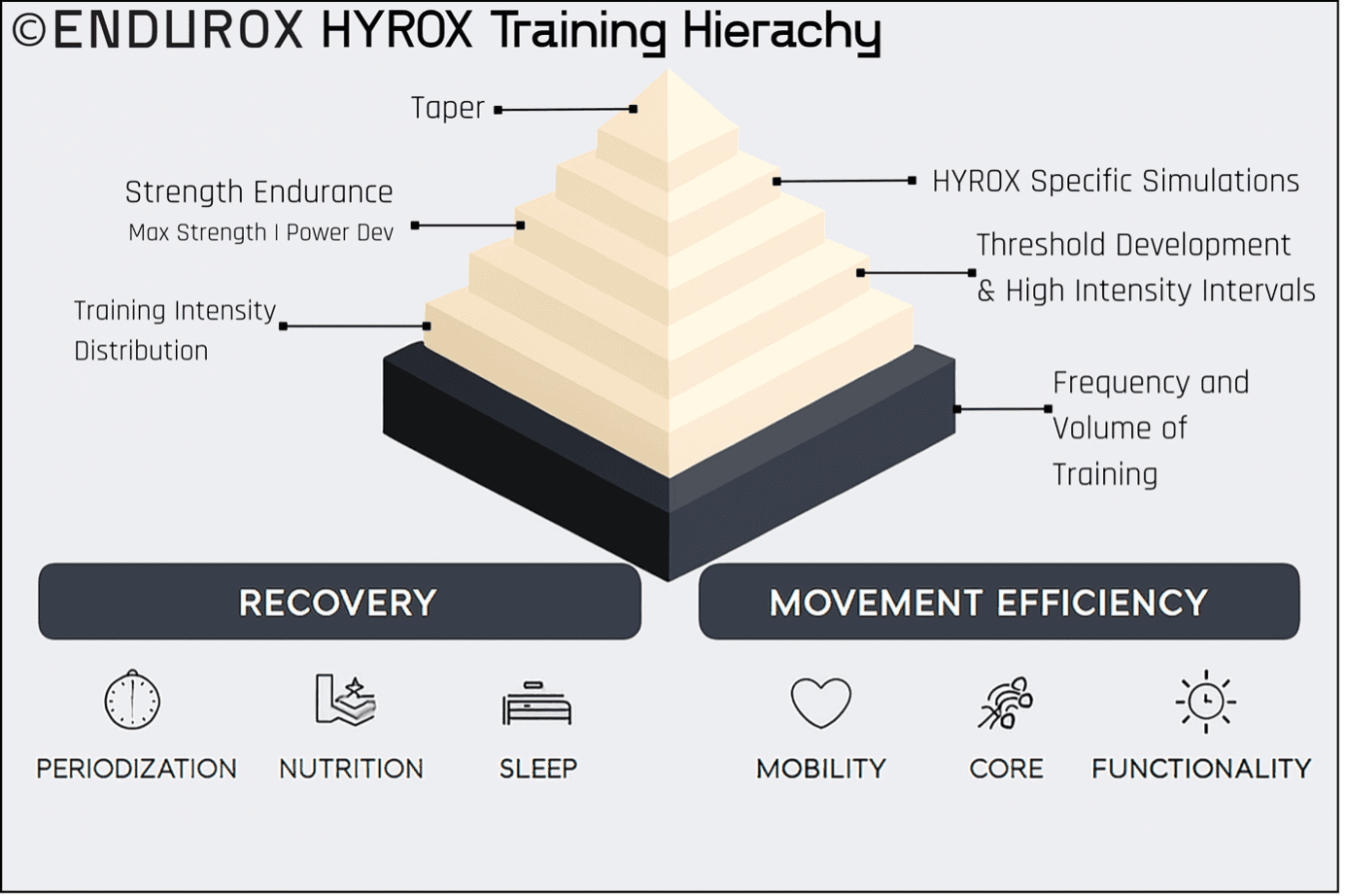
Our approach to HYROX and hybrid training is built around a Hierarchy of Training Needs. The framework has been shaped through years of experience in elite sport and informed by established training science, but at its core it reflects a simple principle: performance qualities must be developed in the right order.
The idea parallels Maslow's hierarchy of needs. In Maslow's model, basic physiological needs sit at the base of the pyramid. Without them, higher-level outcomes cannot be achieved. The structure is sequential.
Training follows the same logic. There is little point in prioritising highly specific race simulations if frequency and volume are insufficient. Each layer depends on the one beneath it. When the base is unstable, everything above it is compromised.
FREQUENCY AND VOLUME OF TRAINING
At the base of the pyramid sits frequency and volume, because training is fundamentally a dose–response relationship. All else being equal, the more you train, the more you adapt, and the better you get. Frequency refers to how many sessions are completed each week, while volume reflects the total training load. The best HYROX athletes train more, consistently over time. Real life imposes constraints — work, family, recovery capacity — but progress still depends on gradually increasing frequency and volume within the limits of what can be sustained.
TRAINING INTENSITY DISTRIBUTION
Once sufficient frequency and volume are in place, intensity distribution becomes the key regulator of whether training can be sustained. For most athletes, this means deliberately keeping most training at a lower intensity, typically below the first aerobic threshold - roughly 70 to 80 percent of training at low intensity, with the remainder at higher intensities. This allows athletes to tolerate higher training volumes, recover effectively, and avoid burnout or injury.
THRESHOLD DEVELOPMENT AND HIGH-INTENSITY INTERVALS
Threshold development comes first. In HYROX, race intensity typically sits close to threshold for a large proportion of the event, often comparable to half-marathon pace. Once threshold work is well tolerated, higher-intensity intervals (toward VO₂max) can be layered in. Athletes with a higher sustainable threshold tend to outperform those with a higher VO₂max but a lower ability to sustain work. Sessions can include EMOMs, metabolic conditioning, and hybrid intervals incorporating SkiErg, Row Erg, wall balls, and other race-specific stations.
STRENGTH ENDURANCE, MAXIMAL STRENGTH, AND POWER DEVELOPMENT
Strength qualities are important but their effectiveness depends on the aerobic and metabolic foundations beneath them. A robust base of maximal strength is a prerequisite for strength endurance. Strength capacity work in the 8–10RM range improves tolerance to sustained tension. Power training improves rate of force development — supporting sled acceleration, efficient transitions, and force output as fatigue accumulates.
HYROX-SPECIFIC RACE SIMULATION
Race simulations sit at the top of the hierarchy. Without the foundations below, simulations are demanding and offer minimal benefit. They are about refining performance — practising the feel of racing, improving movement efficiency, rehearsing transitions, and developing pacing confidence. Typically reserved for later phases of preparation, closer to competition.
TAPERING
Tapering occurs in the final period before competition and is designed to dissipate accumulated fatigue while guarding against detraining. For HYROX, this typically involves a 40–60 percent reduction in training volume, while maintaining frequency and selectively preserving intensity. Short, sharp efforts are retained to maintain running economy and station efficiency.
SUPPORTING STRUCTURES: RECOVERY
Adaptation does not occur during training itself — improvement happens during recovery. Three pillars: periodisation (organising training within microcycles, with lower-intensity sessions placed between higher-intensity days), nutrition (prioritising protein and matching calorie intake to training demands), and sleep (the most powerful recovery variable).
SUPPORTING STRUCTURES: MOVEMENT EFFICIENCY
Small inefficiencies accumulate rapidly across multiple stations and kilometres of running. Movement efficiency includes mobility, core stability, and technical execution across the stations. Integrated throughout the programme rather than as a separate block.
CONCLUSION
Effective preparation is rarely about doing more random hard sessions, and almost always about putting the right work on top of the right work. The hierarchy highlights the bases that need to be covered when preparing for HYROX, supported by recovery and movement efficiency.
Our approach to HYROX and hybrid training is built around a Hierarchy of Training Needs. The framework has been shaped through years of experience in elite sport and informed by established training science, but at its core it reflects a simple principle: performance qualities must be developed in the right order.
The idea parallels Maslow's hierarchy of needs. In Maslow's model, basic physiological needs sit at the base of the pyramid. Without them, higher-level outcomes cannot be achieved. The structure is sequential.
Training follows the same logic. There is little point in prioritising highly specific race simulations if frequency and volume are insufficient. Each layer depends on the one beneath it. When the base is unstable, everything above it is compromised.
FREQUENCY AND VOLUME OF TRAINING
At the base of the pyramid sits frequency and volume, because training is fundamentally a dose–response relationship. All else being equal, the more you train, the more you adapt, and the better you get. Frequency refers to how many sessions are completed each week, while volume reflects the total training load. The best HYROX athletes train more, consistently over time. Real life imposes constraints — work, family, recovery capacity — but progress still depends on gradually increasing frequency and volume within the limits of what can be sustained.
TRAINING INTENSITY DISTRIBUTION
Once sufficient frequency and volume are in place, intensity distribution becomes the key regulator of whether training can be sustained. For most athletes, this means deliberately keeping most training at a lower intensity, typically below the first aerobic threshold - roughly 70 to 80 percent of training at low intensity, with the remainder at higher intensities. This allows athletes to tolerate higher training volumes, recover effectively, and avoid burnout or injury.
THRESHOLD DEVELOPMENT AND HIGH-INTENSITY INTERVALS
Threshold development comes first. In HYROX, race intensity typically sits close to threshold for a large proportion of the event, often comparable to half-marathon pace. Once threshold work is well tolerated, higher-intensity intervals (toward VO₂max) can be layered in. Athletes with a higher sustainable threshold tend to outperform those with a higher VO₂max but a lower ability to sustain work. Sessions can include EMOMs, metabolic conditioning, and hybrid intervals incorporating SkiErg, Row Erg, wall balls, and other race-specific stations.
STRENGTH ENDURANCE, MAXIMAL STRENGTH, AND POWER DEVELOPMENT
Strength qualities are important but their effectiveness depends on the aerobic and metabolic foundations beneath them. A robust base of maximal strength is a prerequisite for strength endurance. Strength capacity work in the 8–10RM range improves tolerance to sustained tension. Power training improves rate of force development — supporting sled acceleration, efficient transitions, and force output as fatigue accumulates.
HYROX-SPECIFIC RACE SIMULATION
Race simulations sit at the top of the hierarchy. Without the foundations below, simulations are demanding and offer minimal benefit. They are about refining performance — practising the feel of racing, improving movement efficiency, rehearsing transitions, and developing pacing confidence. Typically reserved for later phases of preparation, closer to competition.
TAPERING
Tapering occurs in the final period before competition and is designed to dissipate accumulated fatigue while guarding against detraining. For HYROX, this typically involves a 40–60 percent reduction in training volume, while maintaining frequency and selectively preserving intensity. Short, sharp efforts are retained to maintain running economy and station efficiency.
SUPPORTING STRUCTURES: RECOVERY
Adaptation does not occur during training itself — improvement happens during recovery. Three pillars: periodisation (organising training within microcycles, with lower-intensity sessions placed between higher-intensity days), nutrition (prioritising protein and matching calorie intake to training demands), and sleep (the most powerful recovery variable).
SUPPORTING STRUCTURES: MOVEMENT EFFICIENCY
Small inefficiencies accumulate rapidly across multiple stations and kilometres of running. Movement efficiency includes mobility, core stability, and technical execution across the stations. Integrated throughout the programme rather than as a separate block.
CONCLUSION
Effective preparation is rarely about doing more random hard sessions, and almost always about putting the right work on top of the right work. The hierarchy highlights the bases that need to be covered when preparing for HYROX, supported by recovery and movement efficiency.
